an analysis of karen z ho s liquidated rodolfo maggio
An Analysis of Karen Z. Ho's Liquidated - Rodolfo Maggio
Liquidated is a work of anthropology that treats an unusual, despised subculture – that of the Wall Street banker – much as anthropologists have traditionally treated remote ‘savage’ tribes. But using the techniques of ethnography, including interviews, analysis of daily lives, and fieldwork to investigate a modern western culture is not original; what sets Ho''s work apart and gives it value is her mastery of the critical thinking skills of problem-solving and creative thinking to reconceptualize the way in which we understand the bankers'' mindset. Ho''s great achievement is to ask productive questions, most obviously in drawing a distinction between bankers'' self-image as capitalist warriors, freeing up value for themselves and shareholders by increasing the liquidity of the assets they invest in, and the social consequences of what they do. As Ho points out, not only is Wall Street institutionally inclined to embrace risk, in order to maximise profit; it is also prone to assume that increased liquidity (most often achieved by breaking up and selling off the parts of a large corporation) is a good in itself, irrespective of the outcomes for the workers actually involved in these disposals. Considering alternative possibilities, and generating fresh solutions, Ho determines that ... Unknown localization key: "more"
Objev podobné jako An Analysis of Karen Z. Ho's Liquidated - Rodolfo Maggio

An Analysis of Benedict Anderson's Imagined Communities - Jason Xidias
Benedict Anderson’s 1983 masterpiece Imagined Communities is a ground-breaking analysis of the origins and meanings of “nations†and “nationalismâ€. A book that helped reshape the field of nationalism studies, Imagined Communities also shows the critical thinking skills of interpretation and analysis working at their highest levels. One crucial aspect of Anderson’s work involves the apparently simple act of defining precisely what we mean when we say ‘nation’ or ‘nationalism’ – an interpretative step that is vital to the analysis he proceeds to carry out. For Anderson, it is clear that nations are not ‘natural;’ as historians and anthropologists are well aware, nations as we understand them are a relatively modern phenomenon, dating back only as far as around 1500. But if this is the case, how can we agree what a ‘nation’ is? Anderson’s proposed definition is that they are “imagined communities†– comprising groups of people who regard themselves as belonging to the same community, even if they have never met, and have nothing in common otherwise. The analysis that follows from this insight is all about examining and breaking down the historical processes that helped foster these communities – above all the birth of printing, and the development ... Unknown localization key: "more"
Objev podobné jako An Analysis of Benedict Anderson's Imagined Communities - Jason Xidias

An Analysis of Mahmood Mamdani's Citizen and Subject - Meike de Goede
Mahmood Mamdani’s 1996 Citizen and Subject is a powerful work of analysis that lays bare the sources of the problems that plagued, and often still plague, African governments. Analysis is one of the broadest and most fundamental critical thinking skills, and involves understanding the structure and features of arguments. Mamdani’s strong analytical skills form the basis of an original investigation of the problems faced by the independent African governments in the wake of the collapse of the colonial regimes imposed by European powers such has Great Britain and France. It had long been clear that these newly-independent governments faced many problems – corruption, the imposition of anti-democratic rule, and many basic failures of day-to-day governance. They also tended to replicate many of the racially and ethnically prejudiced structures that were part of colonial rule. Mamdani analyses the many arguments about the sources of these problems, drawing out their hidden implications and assumptions in order to clear the way for his own creative new vision of the way to overcome the obstacles to democratization in Africa. A dense and brilliant analysis of the true nature of colonialism’s legacy in Africa, Mamdani’s book remains influential to this day.
Objev podobné jako An Analysis of Mahmood Mamdani's Citizen and Subject - Meike de Goede
Podívejte se také
halogenový ohřívač Orava HO-82 1200W
Pinot Noir z vinice Nová hora
koupelnový žebříkový radiátor HOPA černá matná
nízké outdoorové boty pro hory
kvalitní rukavice na hory
nejvyšší hora Gruzie puzzle
1000 dílků puzzle hory
Panini Holo Giants limitované karty
terč pro trénink míření a hodu
kniha jak vznikají hory a déšť
kalhoty pro děti na hory a na hřiště
lehké běžecké šortky na hory
hřejivá bunda HI-THERM na hory
držák na kartáčky HOPA 70x95x105 mm
bundy ALPINE PRO pro hory a město
kompaktní wobler pro daleké hody
An Analysis of Roland Barthes's Mythologies - John E. Gomez
Mythologies is a masterpiece of analysis and interpretation. At its heart, Barthes’s collection of essays about the “mythologies” of modern life treats everyday objects and ideas – from professional wrestling, to the Tour de France, to Greta Garbo’s face – as though they are silently putting forward arguments. Those arguments are for modernity itself, the way the world is, from its class structures, to its ideologies, to its customs. In Barthes’s view, the mythologies of the modern world all tend towards one aim: making us think that the way things are, the status quo, is how they should naturally be. For Barthes, this should not be taken for granted; instead, he suggests, it is a kind of mystification, preventing us from seeing things differently or believing they might be otherwise. His analyses do what all good analytical thinking does: he unpicks the features of the arguments silently presented by his subjects, reveals their (and our) implicit assumptions, and shows how they point us towards certain ideas and conclusions. Indeed, understanding Barthes’ methods of analysis means you might never see the world in the same way again. Six skills combine to make up our ability to think critically. Mythologies is an ... Unknown localization key: "more"
Objev podobné jako An Analysis of Roland Barthes's Mythologies - John E. Gomez

An Analysis of Jared Diamond's Guns, Germs & Steel - Riley Quinn
In his 1997 work Guns, Germs and Steel, Jared Diamond marshals evidence from five continents and across 13,000 years of human history in an attempt to answer the question of why that history unfolded so differently in various parts of the globe. His results offer new explanations for why the unequal divisions of power and wealth so familiar to us today came into existence – and have persisted.Balancing materials drawn from a vast range of sources, addressing core problems that have fascinated historians, anthropologists, biologists and geographers alike – and blending his analysis to create a compelling narrative that became an international best-seller and reached a broad general market – required a mastery of the critical thinking skill of reasoning that few other scholars can rival. Diamond’s reasoning skills allow him to persuade his readers of the value of his interdisciplinary approach and produce well-structured arguments that keep them turning pages even as he refocuses his analysis from one disparate example to another. Diamond adds to that a spectacular ability to grasp the meaning of the available evidence produced by scholars in those widely different disciplines – making Guns, Germs and Steel equally valuable as an exercise in high-level interpretation.
Objev podobné jako An Analysis of Jared Diamond's Guns, Germs & Steel - Riley Quinn
An Analysis of John P. Kotter's Leading Change - Nick Broten, Yaamina Salman
John P. Kotter’s Leading Change: Why Transformation Efforts Fail is a classic of business literature, and an example of high-level analysis and evaluation. In critical thinking, analysis is all about the sequence and features of arguments. When combined with evaluation of the strengths and weaknesses of an argument, it provides the perfect basis for understanding corporate strategies and direction. Kotter applied these skills to his own experiences of coaching large and small businesses through changes aimed at improving their performance.At its heart, Kotter’s conclusion was simple: unsuccessful transformations usually result from poor management decisions. His view was that it was not enough for executives to have management skills. Strong leadership is required, together with a clear process that can be used by all kinds of companies and organizations, no matter what sector they are operating in. Looking at his own successes and failures alike, Kotter used his analytical skills to understand the sequence and features of relevant arguments before evaluating their strengths and distilling them down to identify common mistakes managers make when they try to implement change. This practical application of two core critical thinking skills allowed him to develop an eight-stage model for successful organizational transformation – a ... Unknown localization key: "more"
Objev podobné jako An Analysis of John P. Kotter's Leading Change - Nick Broten, Yaamina Salman

An Analysis of Eric Hoffer's The True Believer - Jonah S. Rubin
Eric Hoffer’s The True Believer: Thoughts on the Nature of Mass Movements is one of the most widely read works of social psychology written in the 20th-century. It exemplifies the powers of creative thinking and critical analysis at their best, providing an insight into two crucial elements of critical thinking.Hoffer is likely to go down in history as one of America’s great creative thinkers – a writer not bound by standard frameworks of thinking or academic conventions, willing to beat his own path in framing the best possible answers to the questions he investigated. An impoverished, largely unschooled manual laborer who had survived the worst effects of the Great Depression in the United States, Hoffer was a passionate autodidact whose philosophical and psychological education came from omnivorous reading. Working without the help of any mentors, he forged the fearsomely creative and individual approach to problems demonstrated in The True Believer.The book, which earned him his reputation, examines the different phenomena of fanaticism – religious or political – and applies Hoffer’s analytical skills to reveal that, deep down, all ‘true believers’ display the same needs and tendencies, whatever their final choice of belief. Incisive and persuasive, it remains a classic.
Objev podobné jako An Analysis of Eric Hoffer's The True Believer - Jonah S. Rubin
An Analysis of Ludwig Wittgenstein's Philosophical Investigations - Michael O'Sullivan
Many still consider Ludwig Wittgenstein’s 1953 Philosophical Investigations to be one of the breakthrough works of twentieth-century philosophy. The book sets out a radically new conception of philosophy itself, and demonstrates all the attributes of a fine analytical mind. Taking an argument from Plato and subjecting it to detailed (and very clear) analysis, Wittgenstein shows his understanding of how the sequence and function of differing parts of a highly-complex argument can be broken down and assessed. In so doing, he reaches a logical position of simultaneous agreement and disagreement with Plato’s philosophical position. Philosophical Investigations is also a powerful example of the skill of interpretation. Philosophical problems often arise from confusions in the use of language – and the way to solve these problems, Wittgenstein posits, is by clarifying language use. He argues that philosophers must study ordinary uses of language and examine how people use it as a tool in their everyday lives. In this highly-interpretative way, the meaning of a word or sentence becomes relative to the context (people, culture, community) in which it is used. Rather than debate abstract problems, Wittgenstein urges philosophers to concern themselves with ordinary life and the concrete situations in which humans find ... Unknown localization key: "more"
Objev podobné jako An Analysis of Ludwig Wittgenstein's Philosophical Investigations - Michael O'Sullivan
An Analysis of G.E.M. Anscombe's Modern Moral Philosophy - Jonny Blamey, Jon W. Thompson
Elizabeth Anscombe’s 1958 essay “Modern Moral Philosophy†is a cutting intervention in modern philosophy that shows the full power of good evaluative and analytical critical thinking skills. Though only 16 pages long, Anscombe’s paper set out to do nothing less than reform the entire field of modern moral philosophy – something that could only be done by carefully examining the existing arguments of the giants of the field. To do this, she deployed the central skills of evaluation and analysis. In critical thinking, analysis helps understand the sequence and features of arguments: it asks what reasons these arguments produce, what implicit reasons and assumptions they rely on, what conclusions they arrive at. Evaluation involves judging whether or not the arguments are strong enough to sustain their conclusions: it asks how acceptable, adequate, and relevant the reasons given are, and whether or not the conclusions drawn from them are really valid. In “Modern Moral Philosophy,†Anscombe dispassionately turns these skills on figures that have dominated moral philosophy since the 18th-century, revealing the underlying assumptions of their work, their weaknesses and strengths, and showing that in many ways the supposed differences between their arguments are actually negligible. A brilliantly incisive piece, “Modern ... Unknown localization key: "more"
Objev podobné jako An Analysis of G.E.M. Anscombe's Modern Moral Philosophy - Jonny Blamey, Jon W. Thompson
An Analysis of Virginia Woolf's A Room of One's Own - Fiona Robinson, Tim Smith-Laing
A Room of One''s Own is a very clear example of how creative thinkers connect and present things in novel ways. Based on the text of a talk given by Virginia Woolf at an all-female Cambridge college, Room considers the subject of ''women and fiction.'' Woolf’s approach is to ask why, in the early 20th century, literary history presented so few examples of canonically ''great'' women writers. The common prejudices of the time suggested this was caused by (and proof of) women''s creative and intellectual inferiority to men. Woolf argued instead that it was to do with a very simple fact: across the centuries, male-dominated society had systematically prevented women from having the educational opportunities, private spaces and economic independence to produce great art. At a time when ''art'' was commonly considered to be a province of the mind that had no relation to economic circumstances, this was a novel proposal. More novel, though, was Woolf''s manner of arguing and proving her contentions: through a fictional account of the limits placed on even the most privileged women in everyday existence. An impressive early example of cultural materialism, A Room of One''s Own is an exemplary encapsulation of creative thinking.
Objev podobné jako An Analysis of Virginia Woolf's A Room of One's Own - Fiona Robinson, Tim Smith-Laing
An Analysis of G.W.F. Hegel's Phenomenology of Spirit - Paul Jackson
Hegel’s 1807 Phenomenology of Spirit is renowned for being one of the most challenging and important books in Western philosophy. Above all, it is famous for laying out a new approach to reasoning and philosophical argument, an approach that has been credited with influencing Karl Marx, Jean-Paul Sartre, and many other key modern philosophers. That approach is the so-called “Hegelian dialectic” – an open-ended sequence of reasoning and argument in which contradictory concepts generate and are incorporated into a third, more sophisticated concept. While the Phenomenology does not always clearly use this dialectical method – and it is famously one of the most difficult works of philosophy ever written – the Hegelian dialectic provides a perfect template for critical thinking reasoning skills. A hallmark of good reasoning in the construction of an argument, and the searching out of answers must necessarily consider contradictory viewpoints or evidence. For Hegel, contradiction is key: it is precisely what allows reasoning to progress. Only by incorporating and overcoming contradictions, according to his method, is it possible for thought to progress at all. While writing like Hegel might not be advisable, thinking like him can help take your reasoning to the next level. Ian Jackson ... Unknown localization key: "more"
Objev podobné jako An Analysis of G.W.F. Hegel's Phenomenology of Spirit - Paul Jackson
An Analysis of Elaine Tyler May's Homeward Bound - Jarrod Homer
Elaine Tyler May’s 1988 Homeward Bound: American Families in the Cold War Era is a ground-breaking piece of historical and cultural analysis that uses its findings to build a strong argument for its author’s view of the course of modern US history. The aim of May’s study is to trace the links between Cold War politics and the domestic lives of everyday American families at the time. Historians have long noted the unique domestic trends of 1950s America, with its increased focus on the nuclear family, neatly divided traditional gender roles and aspirational, suburban consumer lifestyles. May’s contribution was to analyse the interplay between the domestic scene and the political ideologies of American government, and then to build a carefully-constructed argument that draws attention to the ways in which these seemingly disparate forces are in fact related. May’s key achievement was to use her analytical skills to understand the relationships between these different factors. She traced ways in which domestic life and US foreign policy mirrored one another, showing that the structures and processes they aimed for, while different in scale, were essentially the same. She then carefully brought together different types of historical data, organizing her study to produce ... Unknown localization key: "more"
Objev podobné jako An Analysis of Elaine Tyler May's Homeward Bound - Jarrod Homer
An Analysis of Nassim Nicholas Taleb's The Black Swan - Eric R. Lybeck
One of the primary qualities of good creative thinking is an intellectual freedom to think outside of the box. Good creative thinkers resist orthodox ideas, take new lines of enquiry, and generally come at problems from the kinds of angles almost no one else could. And, what is more, when the ideas of creative thinkers are convincing, they can reshape an entire topic, and change the orthodoxy for good. Nassim Nicholas Taleb’s 2007 bestseller The Black Swan: The Impact of the Highly Improbable is precisely such a book: an entertaining, polemical, creative attack on how people in general, and economic experts in particular view the possibility of catastrophic events. Taleb writes with rare creative verve for someone who is also an expert in mathematics, finance, and epistemology (the philosophy of knowledge), and he martials all his skills to turn standard reasoning inside out. His central point is that far from being unimportant, extremely rare events are frequently the most important ones of all: it is highly improbable, but highly consequential occurrences – what he calls Black Swans – that have shaped history most. As a result, Taleb concludes, improbability is not a reason to act as if a possible event ... Unknown localization key: "more"
Objev podobné jako An Analysis of Nassim Nicholas Taleb's The Black Swan - Eric R. Lybeck

An Analysis of Betty Friedan's The Feminine Mystique - Elizabeth Whitaker
Betty Friedan''s book The Feminine Mystique is possibly the best-selling of all the titles analysed in the Macat library, and arguably one of the most important. Yet it was the product of an apparently minor, meaningless assignment. Undertaking to approach former classmates who had attended Smith College with her, 10 years after their graduation, the high-achieving Friedan was astonished to discover that the survey she had undertaken for a magazine feature revealed a high proportion of her contemporaries were suffering from a malaise she had thought was unique to her: profound dissatisfaction at the ‘ideal’ lives they had been living as wives, mothers and homemakers. For Friedan, this discovery stimulated a remarkable burst of creative thinking, as she began to connect the elements of her own life together in new ways. The popular idea that men and women were equal, but different – that men found their greatest fulfilment through work, while women were most fulfilled in the home – stood revealed as a fallacy, and the depression and even despair she and so many other women felt as a result was recast not as a failure to adapt to a role that was the truest expression of femininity, but ... Unknown localization key: "more"
Objev podobné jako An Analysis of Betty Friedan's The Feminine Mystique - Elizabeth Whitaker
An Analysis of Stanley Milgram's Obedience to Authority - Mark Gridley, William J. Jenkins
Stanley Milgram is one of the most influential and widely-cited social psychologists of the twentieth century. Recognized as perhaps the most creative figure in his field, he is famous for crafting social-psychological experiments with an almost artistic sense of creative imagination – casting new light on social phenomena in the process. His 1974 study Obedience to Authority exemplifies creative thinking at its most potent, and controversial. Interested in the degree to which an “authority figure†could encourage people to commit acts against their sense of right and wrong, Milgram tricked volunteers for a “learning experiment†into believing that they were inflicting painful electric shocks on a person in another room. Able to hear convincing sounds of pain and pleas to stop, the volunteers were told by an authority figure – the “scientist†– that they should continue regardless. Contrary to his own predictions, Milgram discovered that, depending on the exact set up, as many as 65% of people would continue right up to the point of “killing†the victim.The experiment showed, he believed, that ordinary people can, and will, do terrible things under the right circumstances, simply through obedience. As infamous and controversial as it was creatively inspired, the “Milgram ... Unknown localization key: "more"
Objev podobné jako An Analysis of Stanley Milgram's Obedience to Authority - Mark Gridley, William J. Jenkins

An Analysis of Francis Fukuyama's The End of History and the Last Man - Ian Jackson, Jason Xidias
Francis Fukuyama’s controversial 1992 book The End of History and the Last Man demonstrates an important aspect of creative thinking: the ability to generate hypotheses and create novel explanations for evidence. In the case of Fukuyama’s work, the central hypothesis and explanation he put forward were not, in fact, new, but they were novel in the academic and historical context of the time. Fukuyama’s central argument was that the end of the Cold War was a symptom of, and a vital waypoint in, a teleological progression of history. Interpreting history as “teleological†is to say that it is headed towards a final state, or end point: a state in which matters will reach an equilibrium in which things are as good as they can get. For Fukuyama, this would mean the end of “mankind’s ideological evolution and the universalization of Western liberal democracy as the final form of human governmentâ€. This grand theory, which sought to explain the end of the Cold War through a single overarching hypothesis, made the novel step of resurrecting the German philosopher G.W.F. Hegel’s theory of history – which had long been ignored by practical historians and political philosophers – and applying it to current ... Unknown localization key: "more"
Objev podobné jako An Analysis of Francis Fukuyama's The End of History and the Last Man - Ian Jackson, Jason Xidias

An Analysis of Gordon W. Allport's The Nature of Prejudice - Alexander O’Connor
With his 1954 book The Nature of Prejudice, American psychologist Gordon Allport displays the crucial skill of reasoning, producing and organizing an argument that was persuasive enough to have a major impact not only in universities, but also on government policy. The question that Allport tackled was an old one: why are people so disposed to prejudice against those from other groups? Earlier psychologists had suggested a number of reasons, especially in the case of racial prejudice. Some had suggested that racism was a learned behaviour, conditioned by negative experiences of other races; others that there was an objective rationale to negative racial stereotypes. Allport, however, reasoned that prejudice is essentially a by-product of the necessary mental shortcuts the human brain uses to process the vast amount of information it takes in. Because our brains want to use as little effort as possible, they regularly fall back on simple stereotypes – which easily generate prejudice. Gathering strong evidence for this hypothesis, he reasoned, clearly and persuasively, that our natural cognitive approach is the most significant factor in accounting for prejudice. Going further still, Allport also reasoned that, once this was better understood, social scientists would be able to influence policy-makers ... Unknown localization key: "more"
Objev podobné jako An Analysis of Gordon W. Allport's The Nature of Prejudice - Alexander O’Connor
An Analysis of Mahbub ul Haq's Reflections on Human Development - Riley Quinn
What is the ultimate goal of any human society? There have been many answers to this question. But by producing a series of notably well-structured arguments, economist Mahbub ul Haq’s Reflections on Human Development persuaded readers that the goal should be defined quite simply as the requirement that each society improve the lives of its citizens. If this is the agreed aim, Haq continues, then economic development should be designed to support human development. His well-structured reasoning helped development economists recalibrate much of what had previously been regarded as self-evident; that economic productivity was the main barometer of social well being. The work had a profound effect, and Haq’s thinking helped produce a new understanding of what ‘development’ actually meant. Haq conscientiously mapped out arguments and counter-arguments to persuade readers that development did not simply mean an increase in productivity, but rather an increase in human development – the capability of people to live the lives they want to. By bringing the abstract back to the concrete, Haq reevaluated the neoliberal reasoning that suggested economic development necessarily benefitted everybody. And, by virtue of his strong command of reasoning, Haq showed how economic development provided no guarantees that rich people would ... Unknown localization key: "more"
Objev podobné jako An Analysis of Mahbub ul Haq's Reflections on Human Development - Riley Quinn
An Analysis of Jean Lave and Etienne Wenger's Situated Learning - Charmi Patel
Social anthropologist Jean Lave and computer scientist Etienne Wenger’s seminal Situated Learning helped change the fields of cognitive science and pedagogy by approaching learning from a novel angle. Traditionally, theories of learning and education had focused on processes of cognition – the mental processes of knowledge formation that occur within an individual. Lave and Wenger chose to look at learning not as an individual process, but a social one. As so often with the creative thinking process, a small, simple shift in emphasis was all that was required to show things in an entirely different light. What Situated Learning illustrated – and emphasized – was that learning is dependent on its social situation. Even though the most effective way to learn is through interaction with experts and peers in a community organized around a common interest, the traditional cognitive learning model failed to account for the way in which learners interact with their ‘community of practice.’ The new hypothesis that Lave and Wenger developed was that learning can be seen as a continuously evolving set of relationships situated within a social context. This allowed Lave and Wenger to place discussions of apprenticeship and workplace learning on a new footing – ... Unknown localization key: "more"
Objev podobné jako An Analysis of Jean Lave and Etienne Wenger's Situated Learning - Charmi Patel
An Analysis of David Graeber's Debt - Sulaiman Hakemy
Debt is one of the great subjects of our day, and understanding the way that it not only fuels economic growth, but can also be used as a means of generating profit and exerting control, is central to grasping the way in which our society really works. David Graeber''s contribution to this debate is to apply his anthropologists'' training to the understanding of a phenomenon often considered purely from an economic point of view. In this respect, the book can be considered a fine example of the critical thinking skill of problem-solving. Graeber''s main aim is to undermine the dominant narrative, which sees debt as the natural – and broadly healthy – outcome of the development of a modern economic system. He marshals evidence that supports alternative possibilities, and suggests that the phenomenon of debt emerged not as a result of the introduction of money, but at precisely the same time. This in turn allows Graeber to argue against the prevailing notion that economy and state are fundamentally separate entities. Rather, he says, "the two were born together and have always been intertwined" – with debt being a means of enforcing elite and state power. For Graeber, this evaluation of ... Unknown localization key: "more"
Objev podobné jako An Analysis of David Graeber's Debt - Sulaiman Hakemy

An Analysis of Gustavo Gutierrez's A Theology of Liberation - Marthe Hesselmans
Peruvian priest Gustavo Gutiérrez wanted to solve the problem of how the church could conduct itself to improve the lives of the poor, while consistently positioning itself as politically neutral. Despite being a deeply religious man, Gutiérrez was extremely troubled by the lukewarm way in which Christians in general, and the Catholic Church in particular, acknowledged and supported the poor. In A Theology of Liberation, he asked what he knew was an awkward question, and came to an awkward answer: the Church cannot separate itself from economic and political realities.Jesus showed his love for the poor in practical ways – healing the sick, feeding the hungry, liberating the oppressed. His example showed Gutierrez that economic, political, social and spiritual development are all deeply connected. His problem-solving prowess then led him to conclude that the church had to become politically active if it was to confront poverty and oppression across the world. For Gutierrez, the lives of the poor and oppressed directly reflect the divine life of God.
Objev podobné jako An Analysis of Gustavo Gutierrez's A Theology of Liberation - Marthe Hesselmans

An Analysis of Martin Luther King Jr.'s Why We Can't Wait - Jason Xidias
Martin Luther King’s policy of non-violent protest in the struggle for civil rights in the United States during the second half of the twentieth century led to fundamental shifts in American government policy relating to segregation, and a cultural shift in the treatment of African Americans. King’s 1964 book Why We Can’t Wait creates strong, well-structured arguments as to why he and his followers chose to wage a nonviolent struggle in the fight to advance freedom and equality for black people following ‘three hundred years of humiliation, abuse, and deprivation.’ The author highlights a number of reasons why African Americans must demand their civil rights, including frustration at the lack of political will to tackle racism and inequality. Freedoms gained by African nations after years of colonial rule, as well as the US trumpeting its own values of freedom and equality in an ideological war with the Soviet Union, also played their part. King dealt with the counter-argument that civil rights for blacks would be detrimental to whites in America by explaining that racism is a disease that deeply penetrates both the white and the black psyche. His reasoning dictated that the brave act of nonviolent mass protest would provoke ... Unknown localization key: "more"
Objev podobné jako An Analysis of Martin Luther King Jr.'s Why We Can't Wait - Jason Xidias

An Analysis of William Cronon's Nature's Metropolis - Cheryl Hudson
What caused the rise of Chicago, and how did the city''s expansion fuel the westward movement of the American frontier – and influence the type of society that evolved as a result? Nature''s Metropolis emerged as a result of William Cronon asking and answering those questions, and the work can usefully be seen as an extended example of the critical thinking skill of problem-solving in action. Cronon navigates a path between the followers of Frederick Jackson Turner, author of the thesis that American character was shaped by the experience of the frontier, and revisionists who sought to suggest that the rugged individualism Turner depicted as a creation of life in the West was little but a fiction. For Cronon, the most productive question to ask was not whether or not men forged in the liberty-loving furnace of the Wild West had the sort of impact on America that Turner posited, but the quite different one of how capitalism and political economy had combined to drive the westward expansion of the US. For Cronon, individualism was scarcely even possible in a capitalist machine in which humans were little more than cogs, and the needs and demands of capital, not capitalists, prevailed. ... Unknown localization key: "more"
Objev podobné jako An Analysis of William Cronon's Nature's Metropolis - Cheryl Hudson
An Analysis of John Maynard Keyne's The General Theory of Employment, Interest and Money - John Collins
John Maynard Keynes’s 1936 General Theory of Employment, Interest and Money is a perfect example of the global power of critical thinking. A radical reconsideration of some of the founding principles and accepted axioms of classical economics at the time, it provoked a revolution in economic thought and government economic policies across the world. Unsurprisingly, Keynes’s closely argued refutation of the then accepted grounds of economics employs all the key critical thinking skills: analysing and evaluating the old theories and their weaknesses; interpreting and clarifying his own fundamental terms and ideas; problem solving; and using creative thinking to go beyond the old economic theories. Perhaps above all, however, the General Theory is a masterclass in problem solving. Good problem solvers identify their problem, offer a methodology for solving it, and suggest solutions. For Keynes the problem was both real and theoretical: unemployment. A major issue for governments during the Great Depression, unemployment was also a problem for classical economics. In classical economics, theoretically, unemployment would always disappear. Keynes offered both an explanation of why this was not the case in practice, and a range of solutions that could be implemented through government monetary policy.
Objev podobné jako An Analysis of John Maynard Keyne's The General Theory of Employment, Interest and Money - John Collins

An Analysis of Ha-Joon Chang's Kicking Away the Ladder - Sulaiman Hakemy
South Korean economist Ha-Joon Chang used his 2003 work Kicking Away The Ladder to challenge the central orthodoxies of development economics, using his creative thinking skills to shine new light on an old topic. Creative thinkers are often distinguished by their willingness to challenge received ideas, and this is a central aspect of Chang’s work on development. Before Chang, the received wisdom was that developing countries needed the same kinds of economic policies and institutions as developed countries in order to enjoy the same prosperity. But, as Chang pointed out, the historical evidence showed that First World economic success was, in fact, due to exactly the kinds of state intervention that modern development orthodoxy shuns. Western affluence is the product of precisely the kinds of state control – of protectionism and the setting of price tariffs – that developed countries have since denied the developing world in the name of economic freedom and ‘best practice.’ By insisting that Third World nations should adopt these economic policies themselves, argued Chang, the West is actually stifling Third World economic prospects – kicking away the ladder. His carefully reasoned argument for a novel point of view was closely based on the critical thinking ... Unknown localization key: "more"
Objev podobné jako An Analysis of Ha-Joon Chang's Kicking Away the Ladder - Sulaiman Hakemy
An Analysis of Timothy Snyder's Bloodlands - Helen Roche
A flagbearer for the increasingly fashionable genre of "transnational history," Timothy Snyder''s Bloodlands is, first and foremost, a stunning example of the critical thinking skill of evaluation. Snyder''s linguistic precocity allows him to cite evidence in 10 languages, putting fresh twists on the familiar story of World War II fighting on the Eastern Front from 1941-45. In doing so, he works to humanize the estimated 14 million people who lost their lives as their lands were fought over repeatedly by the Nazis and their Soviet opponents. Snyder also works to link more closely the atrocities committed by Hitler and Stalin, which he insists are far too often viewed in isolation. He focuses heavily on the adequacy and relevance of his evidence, but he also uses the materials he has culled from so many different archives as fuel for an exemplary work of reasoning, forcing readers to confront the grim realities that lie behind terms such as ‘cannibalism’ and ‘liquidation.’ In consequence, Bloodlands has emerged, only a few years after its publication, as one of the seminal works of its era, one that is key to Holocaust studies, genocide studies and area studies, and to sociology as well as to history. ... Unknown localization key: "more"
Objev podobné jako An Analysis of Timothy Snyder's Bloodlands - Helen Roche
An Analysis of Amartya Sen's Development as Freedom - Nick Broten, Janna Miletzki
Amartya Sen uses his 1999 work Development as Freedom to evaluate the processes and outcomes of economic development. Having come to the conclusion that development is best summed up as the expansion of freedom, Sen examines traditional definitions and understandings of the term. He says people tend to think of freedoms as economic (the freedom to enter into market exchanges) or political (the freedom to vote and be an active citizen), and tries to understand why the definition has been so narrow hitherto. He concludes that an evaluation of true freedom must necessarily include the freedom to access social services such as healthcare, sanitation and nutrition, just as much as it must acknowledge economic and political freedoms. Evaluating the relevance of the current thinking behind development, Sen concludes that the term ‘freedom’ cannot simply be about income. In many ways, measuring income does not account for various “unfreedoms†(manmade or natural bars to wellbeing) that hinder development. Sen’s evaluation is all the more powerful for its clarity: "The freedom-centered perspective has a generic similarity to the common concern with "quality of life."
Objev podobné jako An Analysis of Amartya Sen's Development as Freedom - Nick Broten, Janna Miletzki
An Analysis of Thomas Piketty's Capital in the Twenty-First Century - Nick Broten
Thomas Piketty is a fine example of an evaluative thinker. In Capital in the Twenty-First Century, he not only provides detailed and sustained explanations of why he sees existing arguments relating to income and wealth distribution as flawed, but also gives us very detailed evaluations of the significance of a vast amount of data explaining why incomes is distributed in the ways it is.As Piketty stresses, “the distribution question… deserves to be studied in a systematic and methodical fashion.†This stress on evaluating the significance of data leads him to focus on the central evaluative questions, and look in turn at the acceptability, relevance, and adequacy of existing justifications for the unequal distribution of wealth. In doing so, Piketty applies his understanding of the data to answering the deeply important question of what political structures and what policies are necessary to move us towards a more equal society.Piketty’s evaluation of the data supports his argument that inequality cannot be depended on to reduce over time: indeed, without government intervention, it is highly likely to increase. In addition, he evaluates international data to argue that poor countries do not necessarily become less poor as a result of foreign investment. This strong ... Unknown localization key: "more"
Objev podobné jako An Analysis of Thomas Piketty's Capital in the Twenty-First Century - Nick Broten
An Analysis of Robert A. Dahl's Who Governs? Democracy and Power in an American City - Jason Xidias, Astrid Noren Nilsson
American political theorist Robert Dahl’s 1961 work of political theory exhibits deep levels of creative thinking. When Dahl wrote, the American system of liberal democracy was generally considered to be shaped by a small group of powerful individuals who dominate because they are wealthy and influential. But by connecting the evidence in a new way in Who Governs? Dahl argued convincingly against this view.Dahl suggested that power is actually distributed among a number of competing groups, and that each of those groups seeks to influence decisions. He puts forward a definition of political power as the ability to make others do what you want them to, concluding that – while most people do not actively participate in politics and so do not exert a direct influence – power is still fragmented, and citizens do indirectly shape decision-making.Dahl’s novel explanation of the existing evidence emerged from a study of three areas of policy-making in the city of New Haven: political nominations, urban redevelopment, and public education. His research revealed that different people wielded power in each area, and that only the mayor, whose power is checked by those who vote for him, was powerful in all three. These new connections allowed ... Unknown localization key: "more"
Objev podobné jako An Analysis of Robert A. Dahl's Who Governs? Democracy and Power in an American City - Jason Xidias, Astrid Noren Nilsson
An Analysis of Jacques Derrida's Structure, Sign, and Play in the Discourse of the Human Sciences - Tim Smith-Laing
Jacques Derrida’s Structure, Sign, and Play is one of the most controversial and influential philosophical texts of the 20th century. Delivered at a conference on structuralism at Johns Hopkins, the lecture took aim at the critical and philosophical fashions of the time and radically proposing a world in which meaning cannot be pinned down or traced to an origin, but instead is continuously shifting, fleeting, and open to play. Hailed by many as a watershed in philosophy and literary theory, Derrida’s lecture has shaped both disciplines. At once dense, brilliant, and humorous, it is a crucial read for anyone interested in questioning our natural assumptions about meaning in the world.
Objev podobné jako An Analysis of Jacques Derrida's Structure, Sign, and Play in the Discourse of the Human Sciences - Tim Smith-Laing

An Analysis of Daniel Kahneman's Thinking, Fast and Slow - Jacqueline Allan
Thinking, Fast and Slow by Daniel Kahneman offers a general audience access to over six decades of insight and expertise from a Nobel Laureate in an accessible and interesting way. Kahneman’s work focuses largely on the problem of how we think, and warns of the dangers of trusting to intuition – which springs from “fast†but broad and emotional thinking – rather than engaging in the slower, harder, but surer thinking that stems from logical, deliberate decision-making. Written in a lively style that engages readers in the experiments for which Kahneman won the Nobel, Thinking, Fast and Slow’s real triumph is to force us to think about our own thinking.
Objev podobné jako An Analysis of Daniel Kahneman's Thinking, Fast and Slow - Jacqueline Allan
An Analysis of Bernard Bailyn's The Ideological Origins of the American Revolution - Etienne Stockland, Joshua Specht
Historians of the American Revolution had always seen the struggle for independence either as a conflict sparked by heavyweight ideology, or as a war between opposing social groups acting out of self-interest. In The Ideological Origins of the American Revolution, Bernard Bailyn begged to differ, re-examining familiar evidence to establish new connections that in turn allowed him to generate fresh explanations. His influential reconceptualizing of the underlying reasons for America''s independence drive focused instead on pamphleteering – and specifically on the actions of an influential group of ‘conspirators’ who identified, and were determined to protect, a particularly American set of values. For Bailyn, these ideas could indeed be traced back to the ferment of the English Civil War – stemming from radical pamphleteers whose anti-authoritarian ideas crossed the Atlantic and embedded themselves in colonial ideology. Bailyn''s thesis helps to explain the Revolution''s success by pointing out how deep-rooted its founding ideas were; the Founding Fathers may have been reading Locke, but the men they led were inspired by shorter, pithier and altogether far more radical works. Only by understanding this, Bailyn argues, can we understand the passion and determination that allowed the rebel American states to defeat a global superpower.
Objev podobné jako An Analysis of Bernard Bailyn's The Ideological Origins of the American Revolution - Etienne Stockland, Joshua Specht
An Analysis of John W. Dower's War Without Mercy - Jason Xidias, Vincent Sanchez
John Dower’s War Without Mercy is an attempt to resolve the problem of why the United States fought World War II so very differently in the Pacific and European theaters. Specifically, the author sets out to explain why there was such vicious hostility between the US and Japan during the conflict. This was not merely a matter of outrage at Pearl Harbor, and understanding the phenomenon required going beyond the usual strategic, diplomatic and operational records that fuel most histories of war. Dower looked instead for alternate possibilities – and found them. His book argues that the viciousness that marked fighting in the Pacific had deep roots in popular culture which created frightening racial stereotypes of the enemy on both sides of the ocean. Dower''s focus on ‘low culture’ proved to be a useful way of generating alternative possibilities to mainstream thinking about US-Japanese relations. The thinking underpinning the book was innovative, and was challenged by some peers who failed to recognise how profoundly revealing material such as cartoons and cheap magazines could be. But the result was one of the most significant studies of 20th-century history yet written – one that yields a strong, well-reasoned and persuasive solution to ... Unknown localization key: "more"
Objev podobné jako An Analysis of John W. Dower's War Without Mercy - Jason Xidias, Vincent Sanchez
An Analysis of Christopher R. Browning's Ordinary Men - James Chappel, Tom Stammers
Of all the controversies facing historians today, few are more divisive or more important than the question of how the Holocaust was possible. What led thousands of Germans – many of them middle-aged reservists with, apparently, little Nazi zeal – to willingly commit acts of genocide? Was it ideology? Was there something rotten in the German soul? Or was it – as Christopher Browning argues in this highly influential book – more a matter of conformity, a response to intolerable social and psychological pressure?Ordinary Men is a microhistory, the detailed study of a single unit in the Nazi killing machine. Browning evaluates a wide range of evidence to seek to explain the actions of the "ordinary men" who made up reserve Police Battalion 101, taking advantage of the wide range of resources prepared in the early 1960s for a proposed war crimes trial. He concludes that his subjects were not "evil;" rather, their actions are best explained by a desire to be part of a team, not to shirk responsibility that would otherwise fall on the shoulders of comrades, and a willingness to obey authority. Browning''s ability to explore the strengths and weaknesses of arguments – both the survivors'' and ... Unknown localization key: "more"
Objev podobné jako An Analysis of Christopher R. Browning's Ordinary Men - James Chappel, Tom Stammers

An Analysis of Michel Foucault's Discipline and Punish - Rachele Dini, Meghan Kallman
Michel Foucault is famous as one of the 20th-century’s most innovative thinkers – and his work on Discipline and Punish was so original and offered models so useful to other scholars that the book now ranks among the most influential academic works ever published.Foucault’s aim is to trace the way in which incarceration was transformed between the seventeenth and twentieth centuries. What started as a spectacle, in which ritual punishments were focused on the prisoner’s body, eventually became a matter of the private disciplining of a delinquent soul.Foucault’s work is renowned for its original insights, and Discipline and Punish contains several of his most compelling observations. Much of the focus of the book is on making new connections between knowledge and power, leading Foucault to sketch out a new interpretation of the relationship between voir, savoir and pouvoir – or, ‘to see is to know is to have power.’ Foucault also dwells in fascinating detail on the true implications of a uniquely creative solution to the problems generated by incarcerating large numbers of criminals in a confined space – Jeremy Bentham’s ‘panopticon,’ a prison constructed around a central tower from which hidden guards might – or might not – be ... Unknown localization key: "more"
Objev podobné jako An Analysis of Michel Foucault's Discipline and Punish - Rachele Dini, Meghan Kallman
An Analysis of Aristotle's Politics - Riley Quinn, Katherine Berrisford
Aristotle remains one of the most celebrated thinkers of all time in large part thanks to his incisive critical thinking skills. In Politics, which can be considered one of the foundational books of the western political tradition, the focus is on problem-solving, and particularly on the generation and evaluation of alternative possibilities.Aristotle’s aim, in Politics, is to determine how best to organize a society. He looks in turn at several different type of organization – kingship, oligarchy and the polity, or rule in the hands of many – and evaluates the arguments for each in turn. But he takes the exercise further than his predecessors had done. Having concluded that rule by the aristocracy would be preferable, since it would mean rule by citizens capable of taking decisions on behalf of the society as a whole, Aristotle subjects his solution to a further checking process, asking productive questions in order to make a sound decision between alternatives.Politics was ground-breaking in its approach. Unlike previous thinkers, Aristotle based all his ideas on a practical assessment of how they would play out in the real world. Ultimately, Aristotle argues, the problem of self-interest means that the adoption of a mixed constitution – ... Unknown localization key: "more"
Objev podobné jako An Analysis of Aristotle's Politics - Riley Quinn, Katherine Berrisford

An Analysis of Donna Haraway's A Cyborg Manifesto - Rebecca Pohl
Haraway’s ‘A Cyborg Manifesto’ is a key postmodern text and is widely taught in many disciplines as one of the first texts to embrace technology from a leftist and feminist perspective using the metaphor of the cyborg to champion socialist, postmodern, and anti-identitarian politics. Until Haraway’s work, few feminists had turned to theorizing science and technology and thus her work quite literally changed the terms of the debate. This article continues to be seen as hugely influential in the field of feminism, particularly postmodern, materialist, and scientific strands. It is also a precursor to cyberfeminism and posthumanism and perhaps anticipates the development of digital humanities.
Objev podobné jako An Analysis of Donna Haraway's A Cyborg Manifesto - Rebecca Pohl
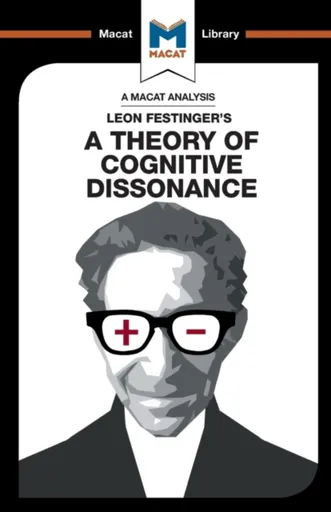
An Analysis of Leon Festinger's A Theory of Cognitive Dissonance - Alexander O’Connor, Camille Morvan
Leon Festinger’s 1957 A Theory of Cognitive Dissonance is a key text in the history of psychology – one that made its author one of the most influential social psychologists of his time. It is also a prime example of how creative thinking and problem solving skills can come together to produce work that changes the way people look at questions for good. Strong creative thinkers are able to look at things from a new perspective, often to the point of challenging the very frames in which those around them see things. Festinger was such a creative thinker, leading what came to be known as the “cognitive revolution†in social psychology. When Festinger was carrying out his research, the dominant school of thought – behaviorism – focused on outward behaviors and their effects. Festinger, however, turned his attention elsewhere, looking at “cognition:†the mental processes behind behaviors. In the case of “cognitive dissonanceâ€, for example, he hypothesized that apparently incomprehensible or illogical behaviors might be caused by a cognitive drive away from dissonance, or internal contradiction. This perspective, however, raised a problem: how to examine and test out cognitive processes. Festinger’s book records the results of the psychological experiments he ... Unknown localization key: "more"
Objev podobné jako An Analysis of Leon Festinger's A Theory of Cognitive Dissonance - Alexander O’Connor, Camille Morvan
An Analysis of C.K. Prahalad and Gary Hamel's The Core Competence of the Corporation - The Macat Team
C.K. Prahalad and Gary Hamel’s 1990 The Core Competence of the Corporation helped redefine traditional ideas of management strategy. It did so by focusing companies on one of the key critical thinking skills: evaluation. In critical thinking, evaluation is all about judging the strengths and weaknesses of arguments – assessing their reasoning and the relevance or adequateness of the evidence they use. For Prahalad and Hamel, companies could gain a competitive edge by evaluating themselves: their own strengths and weaknesses. By sensitively evaluating core competencies – the collective knowledge inside the organization that distinguishes it from other corporations – they could target efforts and resources with strategic focus. For Prahalad and Hamel, managers need to be able to identify and evaluate their company’s unique skill sets, and the technologies that distinguish them from others businesses. How well they then coordinate these elements defines a company’s competitive strength and how quickly it can adapt to new challenges. As Prahalad and Hamel showed in their case studies, the critical thinking skill of evaluation – knowing what you do best, how well you do it, and how you might improve – is absolutely central to staying ahead of the crowd.
Objev podobné jako An Analysis of C.K. Prahalad and Gary Hamel's The Core Competence of the Corporation - The Macat Team
An Analysis of Abraham H. Maslow's A Theory of Human Motivation - Stoyan Stoyanov
US psychologist Abraham H. Maslow’s A Theory of Human Motivation is a classic of psychological research that helped change the field for good. Like many field-changing thinkers, Maslow was not just a talented researcher, he was also a creative thinker – able to see things from a new perspective and show them in a different light. At a time when psychology was dominated by two major schools of thought, Maslow was able to forge a new, third paradigm, that remains influential today. Sigmund Freud’s psychoanalysis had developed the idea of understanding the mind through dialogue between patient and analyst. The behaviorism of Ivan Pavlov and John Watson had focused on comprehending the mind through behaviors that could be measured, trained, and changed. Maslow, however, generated new ideas, forging what he called “positive†or “humanistic psychologyâ€. His argument was that humans are psychologically motivated by a series of hierarchical needs, starting with the most essential first. Maslow thought it important for the advancement of psychology to identify, group and rank these needs in terms of priority. His belief in the value of this third way was important in leading those who studied psychology to redefine the discipline, and so see it ... Unknown localization key: "more"
Objev podobné jako An Analysis of Abraham H. Maslow's A Theory of Human Motivation - Stoyan Stoyanov
An Analysis of James E. Lovelock's Gaia - Mohammad Shamsudduha
Gaia: A New Look At Life on Earth may continue to divide opinion, but nobody can deny that the book offers a powerful insight into the creative thinking of its author, James E. Lovelock. Published in 1979, Gaia offered a radically new hypothesis: the Earth, Lovelock argued, is a living entity. Together, the planet and all its separate living organisms form a single self-regulating body, sustaining life and helping it evolve through time. Lovelock sees humans as no more special than other elements of the planet, railing against the once widely-held belief that the good of mankind is the only thing that matters. Despite being seen as radical, and even idiotic on its publication, a version of Lovelock’s viewpoint has found resonance in contemporary debates about the environment and climate, and has now broadly come to be accepted by modern thinkers. As man’s effects on the climate become increasingly extreme, more and more elements of the Earth’s self-regulation seem to be unveiled – forcing scientists to ask how far the planet might be able to go in order self-regulate effectively. Indeed, despite its far-fetched elements, Lovelock’s Gaia thesis seems to ring more convincingly today than ever before; that it does ... Unknown localization key: "more"
Objev podobné jako An Analysis of James E. Lovelock's Gaia - Mohammad Shamsudduha
An Analysis of Steven Pinker's The Better Angels of Our Nature - Joulia Smortchkova
Reasoning is the critical thinking skill concerned with the production of arguments: making them coherent, consistent, and well-supported; and responding to opposing positions where necessary. The Better Angels of Our Nature offers a step-by-step class in precisely these skills. Author Steven Pinker''s central thesis is simple: mankind has become increasingly less violent over the centuries, and will continue to do so. Pinker is aware, though, that many people instinctively believe the opposite, and Better Angels is devoted to marshalling data to support and illustrate this central argument, as well as a series of secondary arguments about how and why humanity has become less violent. Pinker''s interpretative skills – understanding the meaning of the complex evidence from history – are also on display throughout, as he tackles the ambiguities of his data, the problems it presents, and the viable inferences one can draw from it.
Objev podobné jako An Analysis of Steven Pinker's The Better Angels of Our Nature - Joulia Smortchkova
An Analysis of C.L.R. James's The Black Jacobins - Nick Broten
Today we take it for granted that history is much more than the story of great men and the elites from which they spring. Other forms of history – the histories of gender, class, rebellion and nonconformity – add much-needed context and color to our understanding of the past. But this has not always been so. In CLR James’s The Black Jacobins, we have one of the earliest, and most defining, examples of how ‘history from below’ ought to be written. James''s approach is based on his need to resolve two central problems: to understand why the Haitian slave revolt was the only example of a successful slave rebellion in history, and also to grasp the ways in which its history was intertwined with the history of the French Revolution. The book''s originality, and its value, rests on its author''s ability to ask and answer productive questions of this sort, and in the creativity with which he proved able to generate new hypotheses as a result. As any enduring work of history must be, The Black Jacobins is rooted in sound archival research – but its true greatness lies in the originality of James''s approach.
Objev podobné jako An Analysis of C.L.R. James's The Black Jacobins - Nick Broten
An Analysis of Amos Tversky and Daniel Kahneman's Judgment under Uncertainty - Camille Morvan
Amos Tversky and Daniel Kahneman’s 1974 paper ‘Judgement Under Uncertainty: Heuristics and Biases’ is a landmark in the history of psychology. Though a mere seven pages long, it has helped reshape the study of human rationality, and had a particular impact on economics – where Tversky and Kahneman’s work helped shape the entirely new sub discipline of ‘behavioral economics.’ The paper investigates human decision-making, specifically what human brains tend to do when we are forced to deal with uncertainty or complexity. Based on experiments carried out with volunteers, Tversky and Kahneman discovered that humans make predictable errors of judgement when forced to deal with ambiguous evidence or make challenging decisions. These errors stem from ‘heuristics’ and ‘biases’ – mental shortcuts and assumptions that allow us to make swift, automatic decisions, often usefully and correctly, but occasionally to our detriment. The paper’s huge influence is due in no small part to its masterful use of high-level interpretative and analytical skills – expressed in Tversky and Kahneman’s concise and clear definitions of the basic heuristics and biases they discovered. Still providing the foundations of new work in the field 40 years later, the two psychologists’ definitions are a model of how good ... Unknown localization key: "more"
Objev podobné jako An Analysis of Amos Tversky and Daniel Kahneman's Judgment under Uncertainty - Camille Morvan

An Analysis of Robert D. Putnam's Bowling Alone - Elizabeth Morrow
American political scientist Robert Putnam wasn’t the first person to recognize that social capital – the relationships between people that allow communities to function well – is the grease that oils the wheels of society. But by publishing Bowling Alone, he moved the debate from one primarily concerned with family and individual relationships one that studied the social capital generated by people’s engagement with the civic life. Putnam drew heavily on the critical thinking skill of interpretation in shaping his work. He took fresh looks at the meaning of evidence that other scholars had made too many assumptions about, and was scrupulous in clarifying what his evidence was really saying. He found that strong social capital has the power to boost health, lower unemployment, and improve life in major ways. As such, any decrease in civic engagement could create serious consequences for society. Putnam’s interpretation of these issues led him to the understanding that if America is to thrive, its citizens must connect.
Objev podobné jako An Analysis of Robert D. Putnam's Bowling Alone - Elizabeth Morrow

An Analysis of Sandra M. Gilbert and Susan Gubar's The Madwoman in the Attic - Rebecca Pohl
The 1979 publication of Susan Gubar and Sandra M. Gilbert’s ground-breaking study The Madwoman in the Attic marked a founding moment in feminist literary history as much as feminist literary theory. In their extensive study of nineteenth-century women’s writing, Gubar and Gilbert offer radical re-readings of Jane Austen, the Brontës, Emily Dickinson, George Eliot and Mary Shelley tracing a distinctive female literary tradition and female literary aesthetic. Gubar and Gilbert raise questions about canonisation that continue to resonate today, and model the revolutionary importance of re-reading influential texts that may seem all too familiar
Objev podobné jako An Analysis of Sandra M. Gilbert and Susan Gubar's The Madwoman in the Attic - Rebecca Pohl

An Analysis of Mathis Wackernagel and William Rees's Our Ecological Footprint - Luca Marazzi
Our Ecological Footprint presents a powerful model for measuring humanity’s impact on the Earth to reduce the harm we are causing the planet before it’s too late. While some people believe we can find a middle ground between environmental conservation and economic development, or that future technological discoveries will solve the problem, the authors warn that our planet’s limited resources simply can’t support an economic system based on unlimited growth. Our Ecological Footprint offers a valuable tool to help us live more sustainably and safeguard our natural resources for generations to come.
Objev podobné jako An Analysis of Mathis Wackernagel and William Rees's Our Ecological Footprint - Luca Marazzi

An Introduction to Statistical Mechanics and Thermodynamics - Prof Robert H. Swendsen
An Introduction to Statistical Mechanics and Thermodynamics returns with a second edition which includes new chapters, further explorations, and updated information into the study of statistical mechanics and thermal dynamics.The first part of the book derives the entropy of the classical ideal gas, using only classical statistical mechanics and an analysis of multiple systems first suggested by Boltzmann. The properties of the entropy are then expressed as "postulates" of thermodynamics in the second part of the book. From these postulates, the formal structure of thermodynamics is developed. The third part of the book introduces the canonical and grand canonical ensembles, which are shown to facilitate calculations for many model systems. An explanation of irreversible phenomena that is consistent with time-reversal invariance in a closed system is presented. The fourth part of the book is devoted to quantum statistical mechanics, including black-body radiation, the harmonic solid, Bose-Einstein and Fermi-Dirac statistics, and an introduction to band theory, including metals, insulators, and semiconductors. The final chapter gives a brief introduction to the theory of phase transitions. Throughout the book, there is a strong emphasis on computational methods to make abstract concepts more concrete.
Objev podobné jako An Introduction to Statistical Mechanics and Thermodynamics - Prof Robert H. Swendsen

The Strange Death of Europe - Douglas Murray
THE SUNDAY TIMES NUMBER ONE BESTSELLER A WATERSTONES POLITICS PAPERBACK OF THE YEAR, 2018 The Strange Death of Europe is a highly personal account of a continent and culture caught in the act of suicide. Declining birth-rates, mass immigration and cultivated self-distrust and self-hatred have come together to make Europeans unable to argue for themselves and incapable of resisting their own comprehensive change as a society.This book is not only an analysis of demographic and political realities, but also an eyewitness account of a continent in self-destruct mode. It includes reporting from across the entire continent, from the places where migrants land to the places they end up, from the people who appear to welcome them in to the places which cannot accept them. Told from this first-hand perspective, and backed with impressive research and evidence, the book addresses the disappointing failure of multiculturalism, Angela Merkel’s U-turn on migration, the lack of repatriation and the Western fixation on guilt. Murray travels to Berlin, Paris, Scandinavia, Lampedusa and Greece to uncover the malaise at the very heart of the European culture, and to hear the stories of those who have arrived in Europe from far away. In each chapter he also ... Unknown localization key: "more"
Objev podobné jako The Strange Death of Europe - Douglas Murray
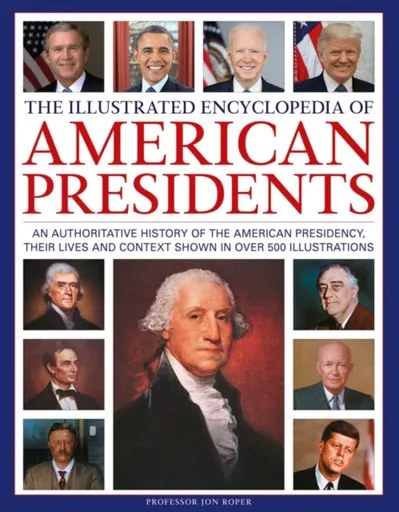
The Illustrated Encyclopedia of American Presidents - Jon Roper
An impressively presented guide to the 47 incumbents who have held the highest-ranking political office in the United States government. • An analysis of the politicians, statesmen and private individuals, and their lasting legacies that have helped shape the course of history • An insightful guide to the role of president from that envisaged by the Founding Fathers of America to the extensive executive powers of the political office today • Each president is presented within the context of major social, political and economic events and developments that have helped to shape the course of world history • Feature boxes present all the facts about each president, including their social, political, and religious backgrounds • Contains more than 460 stunning photographs, fine art paintings, contemporary sketches, artworks and maps This unparalleled reference book is a powerful guide to the 44 incumbents who have held the highest-ranking political office in the United States’ government. An amazing collection of photographs, paintings, sketches, election posters and documents illustrate this authoritative volume. Opening with George Washington, the book provides an in-depth analysis of each US president. Many presidents have shaped world history – Abraham Lincoln and the abolition of slavery, Roosevelt and the Panama ... Unknown localization key: "more"
Objev podobné jako The Illustrated Encyclopedia of American Presidents - Jon Roper